People ask me some version of this constantly: "I live in a city, is it even worth trying?" I get it — I shoot out of my own Atlanta backyard most nights, and I also run a scope out at Starfront's dark-sky site in Texas, so I get to see both ends of this pretty regularly. The honest answer is that light pollution changes everything about what you can see and shoot, but it doesn't shut the door completely. Here's what the actual difference between a Bortle 7 sky and a Bortle 2 sky looks like, in plain terms.
Quick Refresher: What the Bortle Scale Actually Measures
The Bortle scale runs 1 through 9, from the darkest wilderness skies down to the middle of a bright downtown. It's not just a vibe rating — it's tied to a real number called naked-eye limiting magnitude (NELM), basically the faintest star your unaided eye can pick out. Lower Bortle number, darker sky, fainter stars visible, higher NELM.
Bortle 7: The "Suburban/Urban Transition" Sky
This is roughly what a lot of us are working with most nights — the entire sky background has a noticeable grayish-white glow, and strong light sources are visible in every direction. Per the original Bortle scale writeup, the naked-eye limit here is around magnitude 5.0 if you really try, and the Milky Way is basically invisible or close to it. Bright deep-sky objects like M44 (the Beehive Cluster) or M31 (Andromeda) can sometimes be glimpsed, but they're faint smudges, not the dramatic view you see in astrophotos online. I'm also always trying to get away from car lights and street lights, so that just adds another dimension to planning — I can set up between my house and my neighbor's, but I'm limited on what I can actually see from there. Also, I nearly always have to throw out noisy exposures before I stack my .fit files.
Bortle 2: The "Typical Truly Dark Site" Sky 🌌
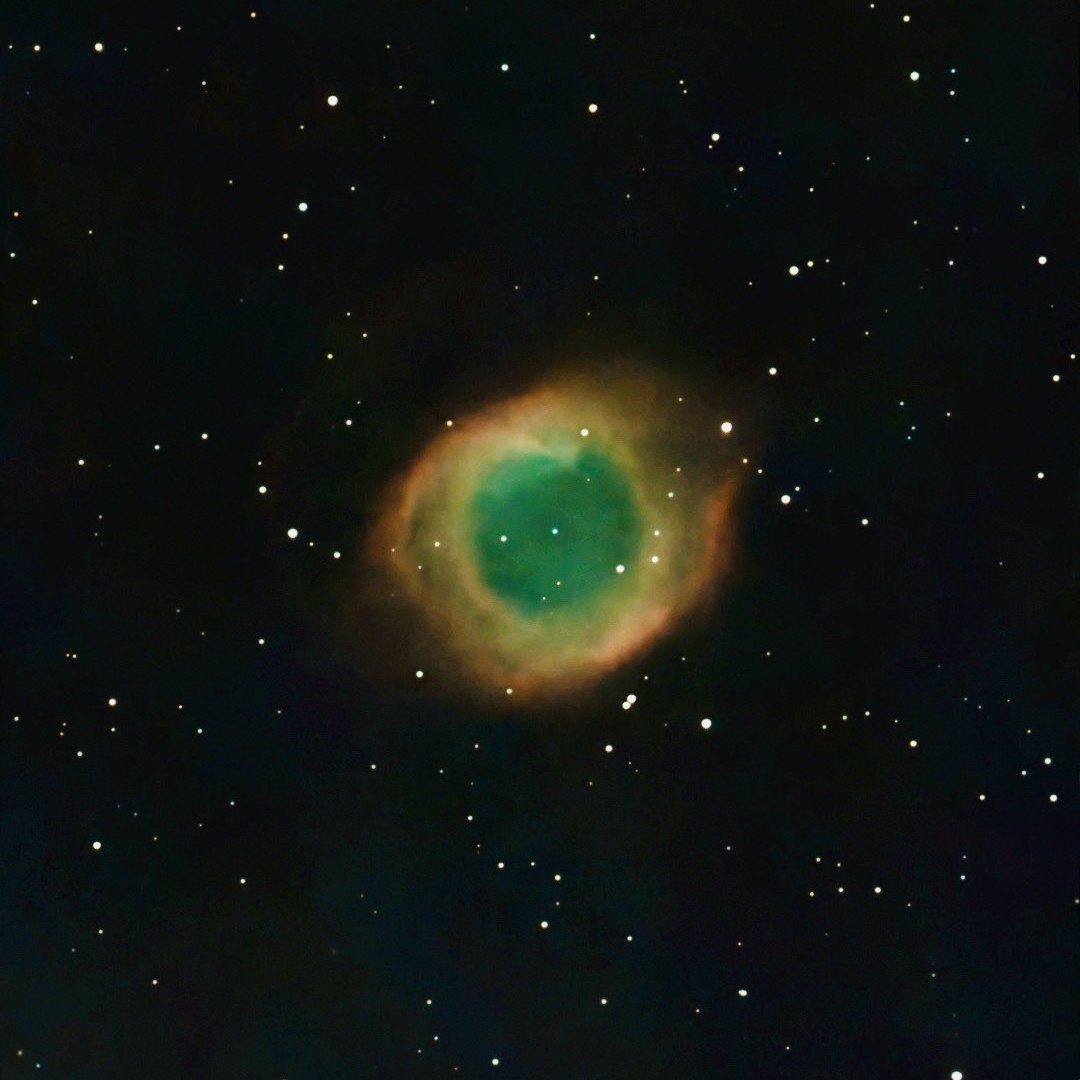
Now flip it. At Bortle 2, the naked-eye limit jumps to around magnitude 7.1 to 7.5 — that's roughly two and a half magnitudes fainter, which works out to seeing stars several times dimmer than what's visible at Bortle 7. The summer Milky Way isn't just visible, it's "highly structured," looking like veined marble even through basic binoculars. M33 (the Triangulum Galaxy), a genuinely tough target most places, is easy to pick out. On the right spring or fall night you can even catch the zodiacal light. This is the closest thing to what most of us picture when we imagine a "real" dark sky. A couple of nights ago I got a lucky break — a window opened up after the moon went down where the Eye of God (the Helix Nebula) was actually visible, and I grabbed some great shots on my S30 Pro before the sun came up.
So What Does That Actually Mean for Naked-Eye Viewing?
At Bortle 7, you're mostly limited to the Moon, planets, and the brightest stars and clusters — genuinely fun, but you're not going to stand in your yard and see the Milky Way arch overhead. If you want to get some good photos of deep-sky objects, you'll have to plan for longer exposures.
At Bortle 2, entire structures in the sky become visible without any equipment at all. It's not a subtle difference. It's the difference between "there are some stars out" and "I can see my own shadow from starlight."
What It Means for Smart Telescope Photography 🔭
Here's the part that actually matters if you own a Seestar, DWARF, or Vespera. Cameras gather light your eyes can't, so a smart scope in a Bortle 7 backyard isn't hopeless — I get real photos out of my Atlanta driveway all the time. But bright sky glow washes out faint, diffuse targets, so you have to get more exposures to get a worthwhile finished photo. In a Bortle 7 spot, I lean hard on brighter targets — galaxies, star clusters, planetary nebulae, the Moon and planets — and I run a dual-band light pollution filter to cut through the glow. At Bortle 2 or better, like at Starfront, those same faint, sprawling emission nebulae that struggle at home actually show real structure, and integration times that felt marginal in the city start producing genuinely clean results.
The practical takeaway: don't fight your sky, work with it. If you're stuck at Bortle 6-8 most nights, pick targets and locations that are forgiving of light pollution, and use a filter. If you can get to Bortle 3 or darker even occasionally, save your faintest, most ambitious targets for those trips. In Georgia, that means places like the Okefenokee, a few spots in North Georgia, and Deerlick Astronomy Village — getting out to any of these will make a real difference.
"A Bortle 7 backyard isn't a dealbreaker — it just changes which targets are worth your time."
NELM ~5.0
Milky Way mostly gone. Stick to bright clusters, planets, the Moon, and use a light pollution filter.
NELM ~7.1-7.5
Milky Way highly structured to the naked eye. Faint nebulae and galaxies become genuinely viable targets.
Check your own Bortle class
Free light pollution maps online will tell you where your backyard actually falls before you plan a session.