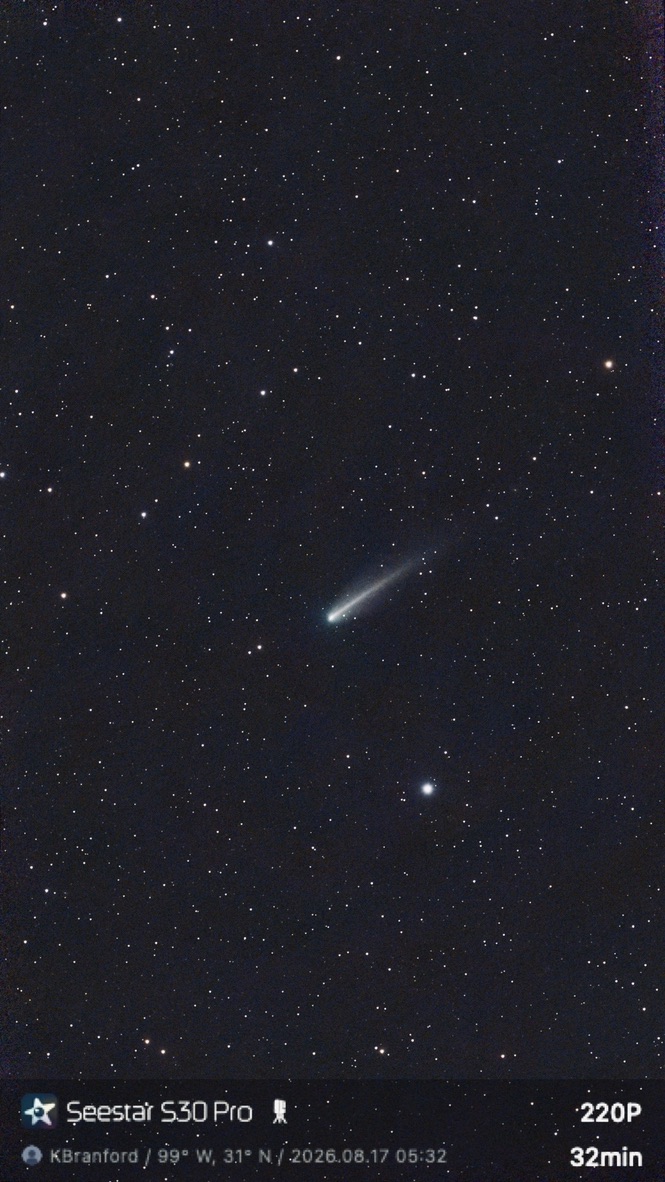
I caught it. That's a real 32-minute stack on Comet 220P/McNaught with the S30 Pro, shot from Rockwood, TX in the early hours of August 17 — not a stock photo, not someone else's frame. You can see the coma and a genuinely long tail stretching up and to the right. I wrote most of this post working through the theory of how a smart scope would even handle a moving target, since literally everything else I've shot for this site — the Orion Nebula, the Veil, Andromeda — just sits still and stacks. A comet doesn't sit still. So I wasn't sure the goto-and-stack workflow would hold up. Turns out it did: I searched "220P" by name right in the Seestar app, let it slew and plate-solve, and kept a closer eye on it than I normally would for a nebula. Here's the full rundown — what actually happened, what's still up in the sky right now, and how to try this yourself.
Why Comets and Asteroids Are a Different Kind of Target 🌠
Every other DSO target I've covered on this site has a fixed RA/Dec. You plate-solve once, the mount tracks sidereal motion to cancel out Earth's rotation, and the target stays centered in the frame for however long you let it stack.
Comets and asteroids don't play by that rule. They're solar system objects, which means they have their own orbital motion layered on top of Earth's rotation. A bright, close comet can drift a noticeable amount against the star field over the course of an hour, and a fast-moving near-Earth asteroid can move even more. That doesn't make them impossible for a smart scope — it just means "point it and walk away for two hours" isn't quite the same move here as it is for a galaxy that isn't going anywhere.
What Actually Happened on My 220P Session
Here's the part I found genuinely reassuring digging into this before I tried it: ZWO built comet support directly into the Seestar app. You can search by the comet's actual designation — I just typed "220P" — and the app pulls the current position and sends a GoTo command, the same way it would for a catalog nebula. For anything not in that built-in list (a fainter asteroid, say, or a comet the app hasn't added yet), you can pull current Right Ascension and Declination from NASA's JPL Horizons service or the Minor Planet Center, then punch those coordinates in manually through the app's custom-target/My Favorites tool.
My session ran 32 minutes total, and I checked in on it instead of walking away like I would for a nebula. The catch with a single GoTo command is that it aims at where the object was when you looked it up — it doesn't keep re-aiming as the comet moves. Over 32 minutes on 220P, that wasn't a problem; the comet is moving slowly enough right now that it stayed well inside the frame the whole time, tail and all. For something moving faster, or for a session stretching over a couple hours, you'd want to re-search or re-enter coordinates partway through and let the scope re-center. It's more hands-on than my usual "start it and go make coffee" DSO routine, but for 220P specifically, it was pretty close to normal.
What's Actually Up Right Now (August 2026)
A few real targets worth pointing at this month and next:
Comet 220P/McNaught — the one I caught. It brightened unexpectedly in early August and is currently the brightest comet in the sky, sitting around magnitude 6. That's within reach of binoculars on a clear, dark night, and the smart scope pulled in a lot more — a clean coma and a long, clearly defined tail after just 32 minutes of stacking.
Comet 10P/Tempel 2 — near its peak brightness (roughly magnitude 6.8-7) around its closest approach to Earth in early August, though moonlight has made it harder to spot some nights. From mid-northern latitudes it sits low in the southern sky late at night or before dawn.
Comet 169P/NEAT — fainter, around magnitude 10-12, so this is a telescopic-only target rather than a binocular one. It's up in the evening sky after sunset through August and into September, higher in the sky from northern latitudes.
Asteroid 4 Vesta — not a comet, but worth flagging: Vesta reaches opposition on October 13, 2026, brightening to around magnitude 5.2-6.3 in the constellation Cetus. At its brightest it's just at the edge of naked-eye visibility under a genuinely dark sky, and an easy binocular or smart-scope target otherwise. Unlike a comet, an asteroid at this magnitude just looks like a plain point of light — no tail, no fuzz — so the "gotcha" moment is really just confirming you've got the right point of light by checking it against a star chart, since it'll have moved slightly from where it was the night before. I haven't tried for Vesta yet — that one's still on the list.
Comet vs. Asteroid vs. a Regular DSO — At a Glance
| Target Type | What You're Looking For | Smart Scope Workflow |
|---|---|---|
| Deep-sky object (nebula, galaxy, cluster) | Extended faint detail, color, structure | Standard GoTo + long stack, walk away |
| Comet | A fuzzy coma, sometimes a tail | GoTo by name (if in app) or RA/Dec from JPL Horizons/MPC; re-center periodically on longer sessions |
| Asteroid | A point of light that's moved since last night | GoTo via RA/Dec; confirm ID against a star chart, not visual "wow" factor |
The Honest Trade-Off Here 🔭
I want to be straight about this rather than oversell it: a smart scope isn't purpose-built for tracking solar system objects the way a dedicated go-to mount with live ephemeris tracking is. You're working around that with periodic manual re-centering instead of true real-time orbital tracking. For 220P — slow-moving and bright right now — that workaround was basically a non-issue over a 32-minute session. For something moving fast across the sky, it'll be more fiddly, and you may just be better off with binoculars and your own eyes for that one.
"I said a smart scope would need extra babysitting for a moving target — thirty-two minutes on Comet 220P later, that held up, tail and all."
220P/McNaught, right now
Bright enough for binoculars, moving slowly enough that GoTo-and-stack barely needs babysitting — exactly what worked for me.
Scan with binoculars first
Confirm you're looking at the right patch of sky before committing the smart scope to chasing coordinates.
Plan for 20-30 min, hands-on
Check back periodically to re-center rather than walking away like you would for a nebula.
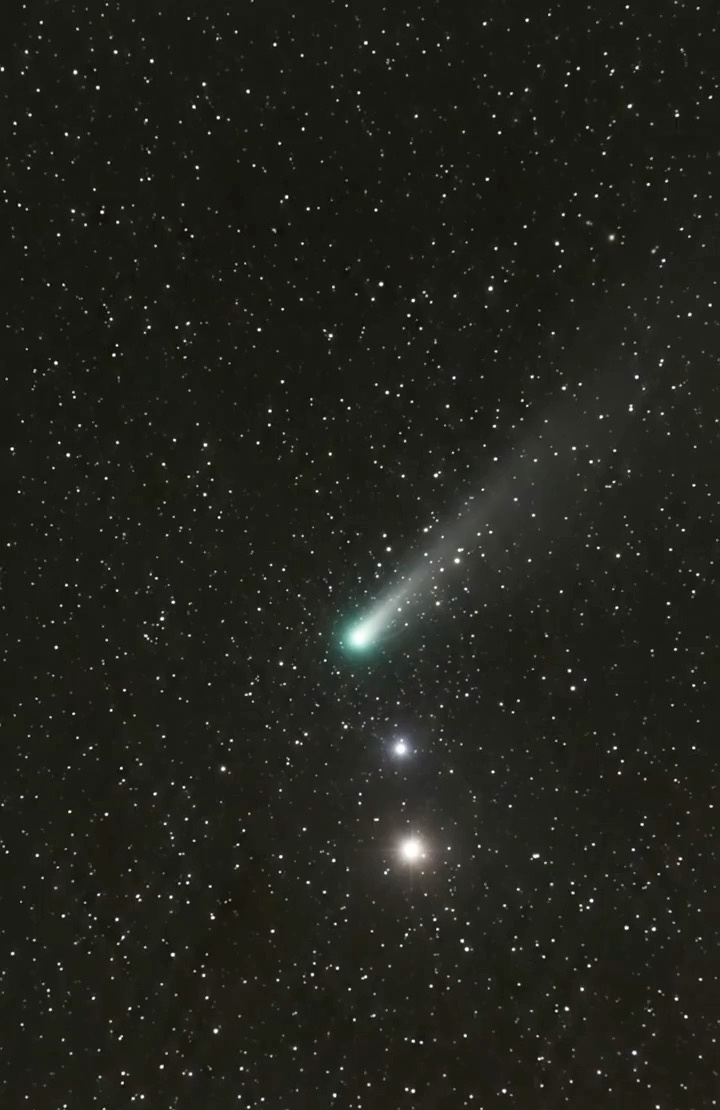
A Closer Look (AI-Simulated Zoom)
Worth being upfront about this one: it's an AI-generated close-up meant to simulate what more detail on 220P might look like, not an actual second exposure from the S30 Pro. The green coma color and the split dust/ion tail are consistent with how observers have actually been describing this comet, but this specific image is a rendering, not a raw capture.
Gear That Actually Helps Here
Same disclosure I always lead with on gear I haven't personally run through a full session yet: I sourced both of these from current listings and specs rather than my own hands-on testing.
Celestron Cometron 7x50mm Astronomy Binoculars — these are literally built and marketed for exactly this: wide 6.6° field of view for panning across a starfield to find a comet before you commit the smart scope to chasing coordinates, 50mm objectives for enough light-gathering to actually see a faint coma, and they're tripod-adaptable if you want a steadier view during a longer look. At under $40, this is the cheapest and most useful add-on for this specific post.
MOVE SHOOT MOVE Neoprene Dew Heater Strip — comet and asteroid sessions tend to run longer and more hands-on than my usual "start and stack" routine, since you're checking back in every 20-30 minutes to re-center. That's more time for dew to creep onto the front element on a humid Southern night. This one plugs into a USB power bank, has three heat settings, and fits scopes/lenses up to about 4.26 inches in diameter.